

This sponsored blog is one in a series by sponsors of the 2026 PQA Annual Meeting. PQA does not endorse, recommend or favor any product, service or organization that is a sponsor. The perspectives shared are those of the author.
Concurrent use of Opioids and Benzodiazepines (COB) and Use of Multiple Anticholinergic Medications in Older Adults (Poly-ACH) are new for the 2027 Star Ratings, reflected in CMS specifications. They arrived alongside an industry-wide reckoning with how prescription drug safety is managed across a Medicare Advantage (MA) plan population where polypharmacy is already the norm.
These measures address a critical healthcare situation. Opioid-benzodiazepine combinations carry roughly ten times the overdose death rate of opioid use alone. Anticholinergic polypharmacy in older adults is linked to cognitive decline, falls and preventable hospitalization. These are not edge cases, but a dangerous potential outcome borne of contraindicated, overlapping prescribing patterns.
New measures with critical timing challenges
COB and Poly-ACH are not adherence measures wearing a new hat. While the three adherence measures reward consistency over the course of a year, these medication safety measures require close and continuous attention to timing of prescriptions and proactive outreach. Plans must identify at-risk members, assess prescribed medications and proactively engage members and their care teams before a 30-day overlap of high-risk medications occurs.
A required attention to timing sets COB and Poly-ACH apart from the classic adherence measures. One member’s medication decision can lead to immediate measure failure with no opportunity for in-year recovery. In the aggregate, a season of high medication overlap activity can quickly tank a plan’s annual performance in these measures. It is no wonder so many plans lose all measure momentum in the first quarter of the calendar year.
Fragmented information across the care team has long complicated healthcare delivery. As a result, members with multiple prescribers often receive conflicting instructions. Primary care physicians write roughly half of all benzodiazepine prescriptions, often without any visibility into what specialists are prescribing their patients. The 30-day threshold is unforgiving, and it keeps running regardless of provider or plan awareness. It’s vital to recognize a potential overlap before the intervention window closes.
The value of identifying when to intervene
Members who eventually become non-compliant with the COB or Poly-ACH measures rarely do so without warning. Utilization history through claims can provide predictive clues: a repeat fill for a short-term opioid, a newly prescribed anticholinergic for incontinence, an ER visit in the prior quarter or a benzodiazepine tied to a past procedure. Plans that are able to identify these signals continuously have real options for proactive tracking and timely intervention. Conversely, plans that wait until a 30-day overlap is evident have already missed the window to intervene, both to impact the measure for the current plan year and to help the member avoid risky drug interactions.
Population risk stratification is critical to the mission—recognizing that not every member requires the same intervention.
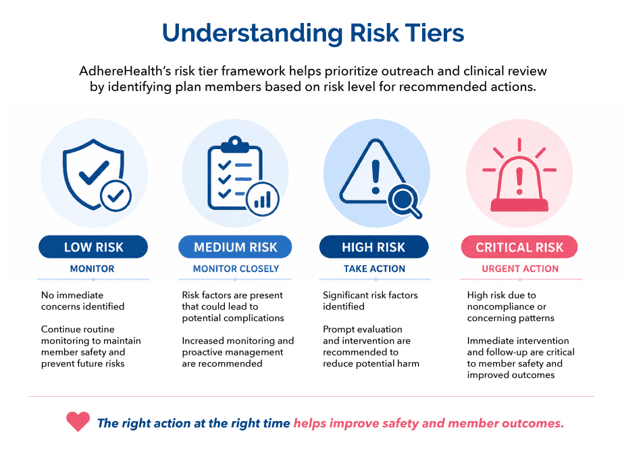
Risk-tiering allows plans to prioritize outreach based on clinical urgency and the likelihood that intervention can change the outcome. Members with emerging medication overlap may only require provider notification and continued monitoring, while those with multiple overlapping high-risk medications, recent hospitalizations or evidence of medication-related complications warrant immediate clinical intervention.
This targeted approach helps clinical teams focus resources where they can have the greatest impact, instead of applying the same workflow across every case.
Organizations may use analytics to continuously evaluate clinical utilization patterns and identify members at elevated risk. At AdhereHealth, these insights are used to support a dynamic risk-tiering approach.
Our approach allows care teams to intervene before members cross the CMS measure threshold, instead of reacting after the opportunity has passed. And for members who have already failed the measure, to proactively get the situation under control before the next measurement year.
Personalized provider engagement is the intervention that moves the needle
Members with multiple chronic conditions are often seeing multiple prescribers, so outreach must reach all of them. National Provider Identifier (NPI)-level prescribing analysis can indicate which provider is generating the overlap; however, it’s important to engage all relevant prescribers, with an understanding of how they fit within various practices. This care team context helps ensure effective coordination and resolution.
The outreach itself requires a comprehensive, coordinated approach. We’ve found that combining EHR-integrated clinical alerts with telephone outreach from Adherence Care Navigators (ACNs) is effective for higher-risk members and peer-to-peer pharmacist consultation in complex cases. Communication is kept concise and actionable to respect busy physician schedules. Effective outreach should name the member, list the medications involved, explain the concern, and offer a path forward that avoids abrasion with the prescriber.
Some cases involve multiple measures. For example, we recently encountered a member I will call “Maria.” Analyzing her claims, we identified overlapping opioid and benzodiazepine use and alerted her prescriber. In response, this physician substituted a muscle relaxant, cyclobenzaprine, to avoid another benzodiazepine. A sound instinct, except cyclobenzaprine is itself anticholinergic, and Maria was already on one for incontinence. Continuous monitoring caught the substitution quickly, and one of our ACNs contacted the prescriber to alert to the new risk. He stopped the prescription and Maria closed the year clear of both measures.
The takeaway? A substitution that solves one problem can quietly create another, and only ongoing surveillance with real clinical follow-through catches that in time. Maria’s experience also illustrates why a layered intervention strategy matters. Lower-risk members may only require surveillance and provider notification, while higher-risk situations benefit from coordinated outreach that combines technology with clinical expertise. Our approach pairs predictive analytics, daily claims monitoring and provider-first engagement so interventions become progressively more intensive as risk increases. This multi-layered prioritization ensures clinical resources are directed toward the members most likely to benefit, while maintaining visibility across the entire population.
Member education as a structural safety component
Providers can only coordinate around what they know, and often the member is the only person who sees the full medication list. Members may not report every prescription to every provider, sometimes because specialists do not share records, or even because an over-the-counter sleep aid doesn’t seem worth mentioning. That gap starts well before a prescriber ever writes a script.
Identifying and addressing these types of risks takes a clinical background coupled with outreach grounded in behavioral science, rather than just compliance language. A conversation that frames medication safety around a member’s own wellbeing, instead of rules and restrictions, is far more likely to prompt an honest conversation with the doctor next time.
What success looks like, and where these measures are heading
COB and Poly-ACH are part of a larger shift in CMS quality programs toward measuring meaningful clinical outcomes rather than process alone. As quality measures continue to evolve, plans that perform well on these measures will share a few habits: identifying risk earlier, intervening more strategically and demonstrating they are helping members achieve better health outcomes—not simply checking boxes.
The capabilities needed to succeed are the same ones that improve medication safety in everyday practice through continuous surveillance, intelligent risk stratification and coordinated provider engagement. By identifying members before they reach a qualifying medication overlap, plans have the opportunity to prevent potentially dangerous clinical situations while also improving performance on COB and Poly-ACH.
Ultimately, improving quality performance and improving patient safety are not competing priorities, but the same objective. Plans that build these capabilities now will be best positioned for the current medication safety measures and for the continued shift toward outcomes-based performance in the years ahead.
Kempton Presley, MPH, MS, is Chief Executive Officer of AdhereHealth, a healthcare technology and services company focused on closing the gap between prescribed care and real-world patient behavior. He is an Adjunct Professor at Vanderbilt University, a former Lecturer at Columbia University and a co-author in the Journal of Biomedical Informatics. He holds degrees from Washington & Lee University, Columbia University and Northwestern University.